Showing posts with label Nursery rhymes. Show all posts

Monday, June 29, 2015

How Much Wood Could A Woodchuck Chuck

How much wood would a woodchuck chuck,
If a woodchuck could chuck wood?
As much wood as a woodchuck would,
If a woodchuck could chuck wood.

There are numerous variations on the answer to this American English-language tongue-twister before the final line “If a woodchuck could chuck wood.”

 … A woodchuck would chuck all the wood he could …
 … He would chuck, he would, as much as he could,
 And chuck as much as a woodchuck would …
 … As much wood as a woodchuck could chuck,…

This is one of the most famous examples of a "tongue twister" or a song that is difficult to say clearly with proper enunciation. The woodchuck ‒ from the Algonquian word, "wejack" or "Wuchak" ‒ is a mammal (or a kind of marmot) native to North America commonly called a groundhog. Woodchucks were not named for their ability to "chuck wood" but rather as a case of converting the Native American name for the creature, into its nearest English pronunciation.

The complete beginning of the tongue twister, "How much wood would a woodchuck chuck if a woodchuck could chuck wood?" relies primarily on alliteration to achieve its effects, with five "w" sounds interspersed among five "ch" sounds.
The origin of the phrase is from a 1902 song, "The Woodchuck Song", written by Robert Howard Davis for Fay Templeton in the musical, The Runaways. The lyrics became better known in a 1904 version of the song written by Theodore Morse, with a chorus of "How much wood would a woodchuck chuck if a woodchuck could chuck wood?", which was recorded by Ragtime Roberts, in 1904.

The answer to the question posed in this tongue twister has been one that many have tried to answer using scientific study, but it isn't really necessary. A 1957 Associated Press piece refers to the question as "a riddle which beats the Sphinx, since it's still unanswered". A more concrete answer was published by the Associated Press in 1988, which reported that a New York fish and wildlife technician named Richard Thomas had calculated the volume of dirt in a typical 25–30-foot (7.6–9.1 m) long woodchuck burrow, and had determined that if the woodchuck had moved an equivalent volume of wood, it could move "about 700 pounds (320 kg) on a good day, with the wind at his back". Another study, which considered "chuck" to be the opposite of upchucking, determined that a woodchuck could ingest 361.9237001 cubic centimetres (22.08593926 cu in) of wood per day.

A traditional, if nonsensical, "response" to the question is: "A woodchuck would chuck as much wood as a woodchuck could chuck if a woodchuck could chuck wood" so even the song doesn’t give a true answer. Another proposed response comes from the parody-filled video game Monkey Island 2: LeChuck's Revenge, where the protagonist asks a carpenter the question and gets the response: "A woodchuck would chuck no amount of wood since a woodchuck can’t chuck wood."...


So moving right along...

We have a wood burner fire that is not only the way we heat our home in the cold winter months but it is connected to a wet back so it heats our water in the wintertime as well. Sometimes it runs so efficiently that the water will actually boil! This is great because I will run a warm wash for our cloths and the bonus is - it is not costing us for hot water to do so.

Normally Harry gets our wood in during the hot days of late summer and early autumn but for some reason this year it never really happened even though I was accused of nagging on the odd occasion.


When it was first cold some friends surprised us with a gift of a ute load of lovely dry wood (part of their own supply) but that soon ran out. So now we have been racing to find some dry wood and get in a supply of our own before it’s too late. We were running the gas heater but it really only heated whoever was sitting the closest to it (and it wasn’t me) and when we needed to buy another tank of LPG we knew it was time to take action.

We are blessed by having a few friends who have farms and so there is often a fallen tree that needs removing as it is taking up grazing space, so we are able to share a little of the wood for our fire. This then only costs the price of fuel for the chain saw and diesel to get there and back a few times so it is truly a wonderful blessing.


(If anyone knows how I can rotate this let me know)


So Harry has been chain sawing and chopping and I have been ‘chucking’ the wood on to the trailer.
So how much did I chuck … as much as I could when it was light enough for me to chuck and the trailer was fill.


It’s a lovely time of togetherness as we work together getting in our supply and just working toward a common good. Harry jokes he just wants a ‘gate opener’ but he has also said it’s a lot quicker if someone is loading up the trailer while he is cutting down and then up the wood (that’s a funny way with words!).


While I am waiting for a new pile of wood to load I will often look for smaller bits and poke them into the gaps of wood which can be used as kindling or just generally getting the fire fuelled up before we place the bigger logs in.


The other day I decided I had some things I needed to get done at home so I didn’t go with Harry and he mentioned that that may be a good thing and it would save time and space from unloading the small bits I had put in. He may scoff now but will often use these small pieces and we will joke at what a great idea it was to collect them, pretending that it was his idea!

And then when we come home the smell of baking and a meal cooking away slowly in the oven is just the thing for hungry tums.


Wednesday, June 10, 2015

Little Miss Muffet

I am not usually scared of spiders and have been known to actually quickly pick up and dispose of a spider if need be, though I prefer to use a glass and bit of cardboard to “capture” and transport them outside.

The other day I was sitting – not on a tuffet – but in the littlest room in the house, when I looked up and there on the wall was a spider. Now I wasn’t too worried as we had seen this spider up in the corners for a few days and it seemed to be keeping to itself, but for it to come “along’” and nearly “sit down beside” me was enough for me to decide it was time for it to be moved out into the big world yonder – of our front door.

Now as you can see this was no little spider. At over three and a half centimeters in length it was not something I was going to pick up in my hand. So it may not have frightened me away but it certainly got removed so that it wouldn't distract me any more from the the needs of nature.

Arachnophobia is the fear of spiders. People with Arachnophobia tend to feel uneasy in any area they believe could harbour spiders or that has visible signs of their presence, such as webs. If arachnophobics see a spider, they may not enter the general vicinity until they have overcome the panic attack that is often associated with their phobia. Some people scream, cry, have trouble breathing, have excessive sweating or even heart trouble when they come in contact with an area near spiders or their webs. In some extreme cases, even a picture or a realistic drawing of a spider can also trigger fear.

Now I can say I definitely don't suffer from arachnophobia but I would assum that Miss Muffet probably did!

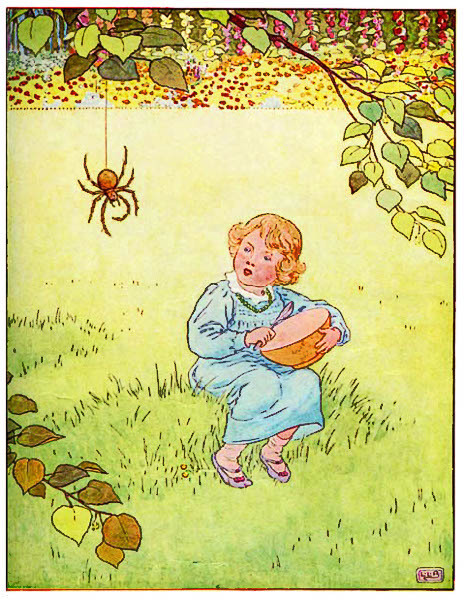
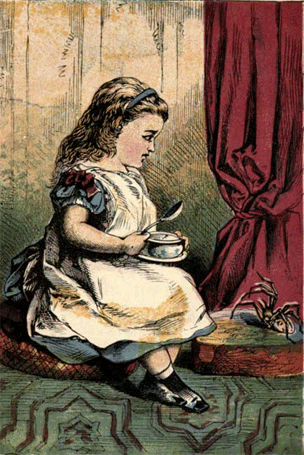
Little Miss Muffet
sat on a tuffet
Eating her curds and whey,
Along came a spider,
Who sat down beside her
And frightened Miss Muffet away.

Some of Mother Goose's rhymes have very old English words in them. Some people say a tuffet can be either a mound, an area of grass (from tuft of grass) a little grassy bump big enough to sit on or a low three-legged stool and others say it is.

Whey is the watery part of milk that separates from the curds when making cheese. It is similar to what we now know as cottage cheese.

Like many such rhymes, its origins are unclear. Little Miss Muffet was a small girl whose name was Patience Muffet. Her stepfather, Dr. Thomas Muffet (possibly Moffett or Moufet), (1553-1604) was an English physician and a famous entomologist who wrote the first scientific catalogue of British Insects The Silkwormes and their flies "lively described in verse". Whilst eating her breakfast of curds and whey Little Miss Muffet was frightened by one of his spiders and ran away! This particular Nursery Rhyme of Little Miss Muffet reputedly dates back to the late 16th century as indicated by the birth date of Dr Muffet!

Most literary scholars, who note that stories linking folk tales or songs to political events are often urban legends. Mother Goose scholars agree that "Little Miss Muffet" is not about the more unlikely story of the staunch Roman Catholic Mary, Queen of Scots. It was suggested that Mary, Queen of Scots (1542-1587), was the little Miss Muffet referred to in the rhyme and that the Scottish religious reformer John Knox (1505 or 1510 – details are sketchy-1572), was the spider who frightened her away. Mary Queen of Scots eventually fled from Scotland due to the hatred of the religious reformers. And is refuted to have said “I fear the prays of John Knox more than all the assembled armies of Europe” Mary Queen of Scots was eventually beheaded in 1572 when she was found guilty of involvement in plans to assonate her cousin Queen Elizabeth I.


Accreditation is deemed shaky by some. The rhyme first appeared in print in 1805, in a book titled Songs for the Nursery, whose 1812 edition read "Little Mary Ester sat upon a tester . . . ." Halliwell's 1842 collection read "Little Miss Mopsey sat in a shopsey . . "


Mary Queen of Scots

Monday, April 20, 2015

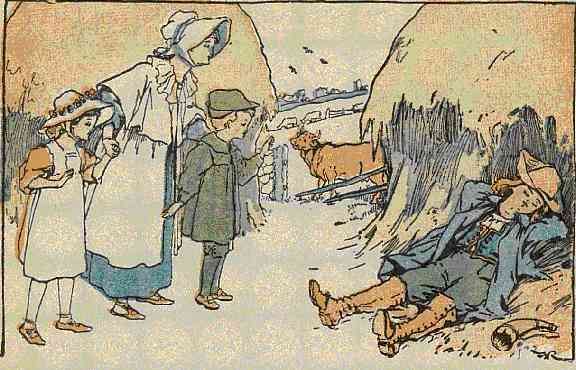
Little Boy Blue

Little Boy Blue By Mother Goose
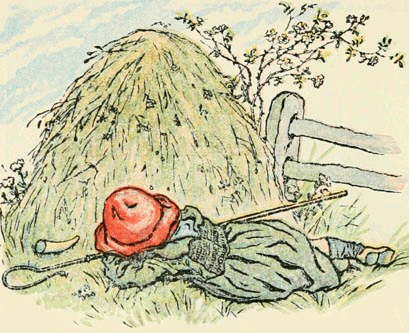
Little boy blue, 
Come blow your horn, 
The sheep's in the meadow, 
The cow's in the corn. 
But where is the boy 
Who looks after the sheep? 
He's under a haystack, 
Fast asleep. 

The additional lines in one version which I know now, but didn’t as a child when I first learnt this rhyme are:

Will you wake him? 
No, not I - for if I do, 
he's sure to cry 


"Little Boy Blue" is a popular English-language nursery rhyme, often used in popular culture. It has a Roud Folk Song Index number of 11318. The earliest printed version of the rhyme is in Tommy Thumb's Little Song Book (c. 1744), but the rhyme may be much older. The Origins of the Little Boy Blue story - A Connection with Tudor History?

The words and story of Little Boy Blue cannot be positively connected to any historical figure in European history but there is, however, a doubtful theory that has been argued that Little Boy Blue was intended to represent Cardinal Thomas Wolsey (1475-1530) who was the son of an Ipswich butcher, dating back to English Tudor history and the reign of King Henry VIII (although the origins and lyrics cannot be connected to any events in his life). Wolsey a prominent English statesman and figure in the Roman Catholic Church during the reign of Henry VIII, was an extremely rich and arrogant self-made man with many enemies at court and was unpopular with the people of England. He was called the "Boy Bachelor" after obtaining his degree from Oxford at the unusually early age of fifteen. The expression "Blowing one's own horn" meaning to brag was certainly practised by Cardinal Wolsey. Between 1514 and 1525 he transformed a medieval manor into the magnificent Hampton Court Palace. It was an ostentatious display of his wealth and his power giving rise to the rhyme uttered by his enemies:

 "Come ye to court? Which Court?
The King's Court or Hampton Court?"

The anti-Wolsey propaganda worked and in 1529 Henry declared all of Wolsey's lands and possessions forfeit and they became the property of the Crown. At this time England was a prosperous nation largely through the wool trade and the export taxes on wool had augmented both Henry's treasury and Wolsey's assets. The words "where's the boy who looks after the sheep?" could refer to Wolsey's concern with profiting himself by lining his own coffers as opposed to that of the country. The cardinal's robes were scarlet but Wolsey's Blazon of Arms included the blue faces of four leopards, as opposed to traditional scarlet cardinal robes - perhaps this was why the title of the rhyme is Little Boy Blue? The Little Boy Blue rhyme may have been a secret message of dissent concerning the greed of the statesman prior to his downfall. Open criticism of the Cardinal would have lead to imprisonment, confiscation of property or even death.

Another theory of the rhyme reputedly relating to Cardinal Wolsey is Wolsey may have acted as a hayward to his father's livestock, but there is no corroborative evidence to support this assertion.

The idea of a sheep eating in a meadow, or a cow eating in the grain field ("corn" means grain in this context) would have been horrifying to the people of the time, since heavy feeding on lush grass can make sheep sick (grass tetany, for example) so the meaning of the rhyme was quite vivid in earlier times.


It may also be alluded to in Shakespeare's King Lear (III, vi) when Edgar, masquerading as Mad Tom, says:

Sleepest or wakest thou, jolly shepheard?
Thy sheepe be in the corne;
And for one blast of thy minikin mouth
Thy sheepe shall take no harme.

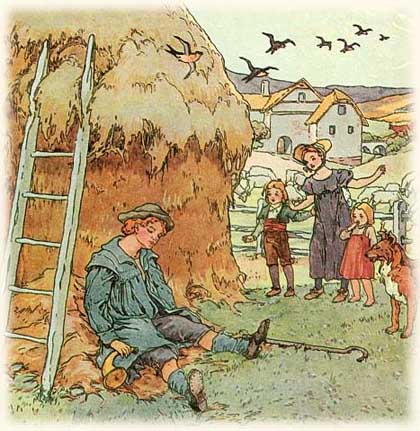
Another version from Mother Goose, The Original Volland Edition (1915), edited and arranged by Eulalie Osgood Grover:

Little Boy Blue, come blow your horn,
The sheep's in the meadow, the cow's in the corn.
What! Is this the way you mind your sheep,
Under the haycock fast asleep?

However it is also noted that the rhyme neither has a moral objective nor is used to demonstrate any specific use of the English language.

The most common belief is that the origins are not based on actual events or people in history but is merely a reflection of peaceful country life which would appeal to the imagination of a young child.


And so leads to my recollection of this rhyme.


I was visiting my good friends, Allan and Frances, one day and as leaving down their driveway I drove past some cows which appeared, when I first looked, to be in the same paddock as maize was being grown. Stopping I looked and saw they were in fact well and truly fenced off. Still, I thought of the rhyme and couldn't resist taking a few shots for a blog post!


Another day while travelling north I came across a small fenced off area by the roadside where all the sheep had been shepherded into an area of roadside grass. It looked a little odd to have so many in a small place, as if they had "got into the meadow".

On another occasion when I was visiting my friends again as I hadn't bought my camera I asked Frances to take some photos of the cows grazing in an area where some of the maize had been harvested. She emailed them to me from her phone and we were quite amazed (no pun intended) at how on transmission the cows ended up looking like they had been photo shopped into the pic! If you look inparticular at the legs of the black and white cows they definitely look photoshopped on But I can assure you they were there!


Sunday, August 31, 2014

Three Little Kittens and My Lost Mittens

I had come to a bit of a standstill with my knitting as I had started a little jacket for one of my grandchildren with some lovely red mohair but I had but run out before I had finished. I couldn't find any in the shops to finish it so I had just stopped altogether.

Then I remembered that I had promised to make some mittens for Kate so quickly made one pair and posted them off.
After the weekend I had spoken to my daughter and she hadn't mentioned them. I thought that was a long time for them to get there and my impression of the New Zealand postal service lowered a bit. However Monday morning there in the letterbox was my parcel - returned!
Insufficient Postage thank you very much!


"Right", I thought, "I'll fix them!" I opened up the parcel, took some photos (as I had forgotten to for the first ones) and slipped the second pair I had made over the weekend in as well. I then "peeled off" the label, affixed the correct postage and sent them off again.

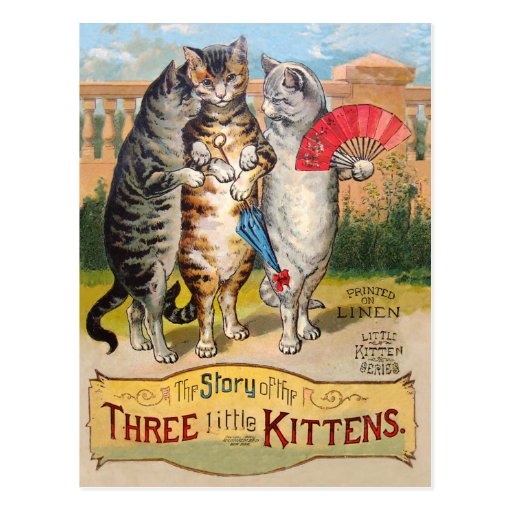
I was reminded of the nursery rhyme

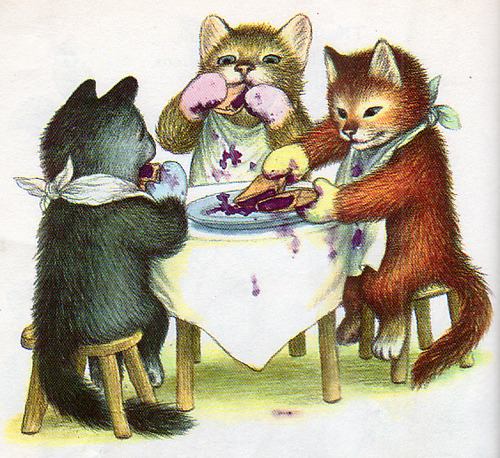
"Three Little Kittens"

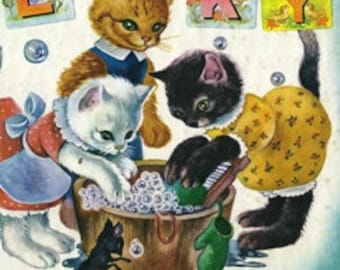
Three little kittens they lost their mittens, 
And they began to cry, 
Oh, mother dear, we sadly fear Our mittens we have lost. 
What! lost your mittens, you naughty kittens! 
Then you shall have no pie. 
Mee-ow, mee-ow, mee-ow. 
No, you shall have no pie. 

The three little kittens they found their mittens, 
And they began to cry, 
Oh, mother dear, see here, see here, Our mittens we have found! 
Put on your mittens, you silly kittens, 
And you shall have some pie. 
Purr-r, purr-r, purr-r, 
Oh, let us have some pie. 

The three little kittens put on their mittens, And soon ate up the pie; 
Oh, mother dear, we greatly fear Our mittens we have soiled. 
What! soiled your mittens, you naughty kittens! 
Then they began to sigh, 
Mee-ow, mee-ow, mee-ow. 
Then they began to sigh. 

The three little kittens they washed their mittens, And hung them out to dry; 
Oh! mother dear, do you not hear, Our mittens we have washed! 
What! washed your mittens, then you’re good kittens, 
But I smell a rat close by. 
Mee-ow, mee-ow, mee-ow. 
We smell a rat close by. 

Historical Background "Three Little Kittens" is an English language nursery rhyme, probably with roots in the British folk tradition. It dates to before 1858, when R. N. Ballantyne wrote an amplification of the poem under the championship The Three Little Kittens, published as region of the Good Little Pig's Library, book 1. An often late edition of the tale was published under the Little Golden Books impression in the United States. The rhyme as published today, however, is a sophisticated piece usually attributed to American poet Eliza Lee Cabot Follen (1787-1860). The poem was first published in Britain in 1833 as an anonymous addition to a volume of Follen's verse “Little Songs for Little Boys and Girls”. and in the United States in 1843. Follen may have developed and refined an existing, rude version of the poem, and, in the process, made it her own. With the passage of time, the poem " was hugely popular and quickly absorbed into the Mother Goose collection, “Only True Mother Goose Melodies” in 1843. Its tune is a variant of “The Seven Joys of Mary.” It has a Roud Folk Song Index number of 16150

You can read more about its origins here.

“Three Little Kittens” tells a cautionary tale of three kittens, who first lose, then find and soil, their mittens. When all is finally set to rights, the kittens receive their mother's approval and some pie. The profound significance of these verses represents a typical situation involving the relationship between a mother and a child. The child, represented by kittens and the common occurrence of losing an article is subsequently punished. Then finding the lost item, the child is finally rewarded for the good deed.

The word "meeow" shows effective use of onomatopoeia where a word sounds like the action. The mother cat was correct in her view that she could "smell a rat!" It may have been that the kittens had indeed been playing with a rat. The fact that the kittens saw the reward in finding their mittens meant they could have pie, suggesting that good behaviour was rewarded; when their mittens were soiled and they were pronounced naughty, supposes that they washed them to be rewarded again. However “Mother” saw through them!

The poem is a sophisticated production considered a cornerstone in the shift from moral literature of 19th century children's literature, in favour of anthropomorphic fantasy, satirical nonsense, and word play. It is one of the first pieces of children's romantic literature produced for amusement and entertainment, and may be the source of the idiom "to smell a rat".

The poem can be learnt in a request and reaction choral manner featuring the sound of a storyteller and the voices of the kittens. Like most rhymes, this verse is unnamed.

So the mittens I made were in a pure wool. I didn't use a pattern as they are generally just a simple 'bag' with a curved top. I made one with a rib cuff feeding some hat elastic through for tightness and the second had a simple picot edge with a band that I was able to thread some thin elastic through. The second pair also had a little 'snowflake' pattern knitted on the back. 


Thursday, July 3, 2014

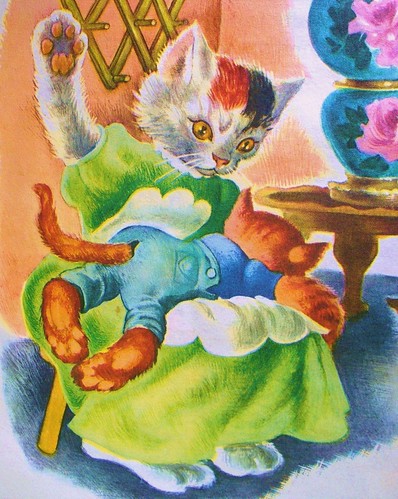
Pussy Cat, Pussy Cat, Where Have You Been?

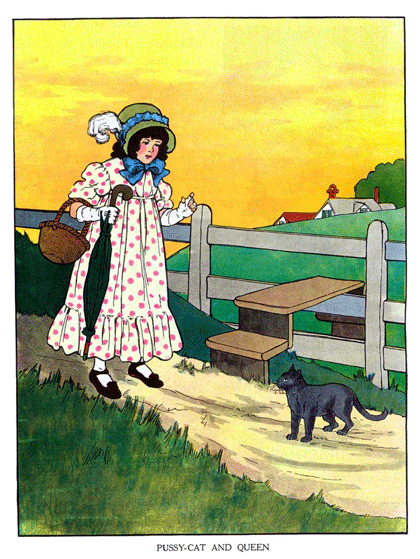
"Pussycat pussycat, where have you been?" 
"I've been up to London to visit the Queen."
"Pussycat pussycat, what did you there?" 
"I frightened a little mouse under her chair" 
"MEOWW!" 

Common modern versions include:
Pussy cat, pussy cat, where have you been?
I've been to London to look at the Queen.
Pussy cat, pussy cat, what did you do there?
I frightened a little mouse, under the chair.

The last line sometimes sung as: I chased a little mouse right under the chair.

The origins of the "Pussycat pussycat" rhyme dates back to the history of 16th century Tudor England.

One of the waiting ladies of Queen Elizabeth Ist, the fifth and last monarch of Tudor England, had an old cat which roamed throughout Windsor castle. On one particular occasion the cat ran beneath the throne where its tail brushed against the Queen's foot, startling her.

Luckily 'Good Queen Bess' had a sense of humour and decreed that the cat could wander about the throne room, on condition it kept it free of mice!

The earliest record of the rhyme is found in the publication "Songs for the Nursery," printed in London in 1805. The melody commonly associated with the rhyme was first recorded by the composer and nursery rhyme collector, James William Elliott, in his "National Nursery Rhymes and Nursery Songs" (1870).

The Queen most often depicted in illustrations is Elizabeth I, but Caroline of Brunswick has also been suggested

Percy B. Green, author of A History of Nursery Rhymes (1899), wrote the following about the Pussycat, Pussycat nursery rhyme: "No doubt the incident giving rise to this verse had to do with the terrible fright Queen Bess (Elizabeth) is supposed to have had on discovering a mouse in the folds of her dress - for it was she of virgin fame to whom pussy-cat paid the visit.

It has been asked again and again, 'Why are old maids so fond of cats?' and 'Why are their lives so linked together?' Maybe it is to scare, as did the cat in the rhyme, 'a little mouse from under her chair.'"

James Orchard Halliwell wrote the following about Pussycat, Pussycat in his book "The Nursery Rhymes of England" (1843): "There is an old proverb which says that 'a cat may look at a king.' Whether the same adage applies equally to a female sovereign, and is referred to in the nursery song, or whether it alludes to the glorious Queen Bess, is now a matter of uncertainty."

While staying at my parents I discovered they were often visited by a cat. He would arrive in the mornings and after a good scratch of his ears and a few cat biscuits he would then roam the house looking for a warm spot to snuggle up in. Sometimes he would go downstairs to where the night store was kept on to dry the clothes and other times he would snuggle down on my mother’s feet as she rested on the couch. On one occasion he slept on my bed.
 
Dad commented that sometimes he wouldn’t come for a few days and after I had been there for a week I realised he would arrive early on week days leaving as the night drew in and kept away at the weekends. I supposed that perhaps his owners shut him out when they went to work but on weekends he was allowed inside during the day.

Needless to say he would arrive at Mum and Dads, sometimes entering in a downstairs door wondering up the stairs to linger for a while and then disappeared out a front door to proceed across the road and up to another place. They have no idea where he lives or even in which direction he comes from but he sure is happy to stay in the warm with a few snacks on the days he does.

It made me think of the rhyme "Pussy cat, pussy cat, where have you been?" and wondered if its owners had any idea what it got up to when they shut him out.