Saturday, May 18, 2013

Diddle, Diddle, Dumpling, My Son John,

Ok, his name's Jacob, not John and he is my grandson, not son, but I had the pleasure of babysitting him the other day while his mummy was at an appointment.
I have been doing this a few times lately now and we are starting to build up a great relationship of Nana and Grandson.

Usually I arrive while he is asleep and there for when he wakes up, but this last time I was putting him to bed. With it being cooler he likes to wear his gumboots all the time and he had a sleeveless jacket and hat on too. I changed his nappy and he was ready for his afternoon nap but wasn't that keen to discard all his favourite garments. Once in his room I was able to get his boots off and coax him out of his hat and jacket once he was in his bed, but he still wanted some books, a 'Thomas" train, trucks and his soft toys.

The rhyme "Diddle, diddle, dumpling, my son John," kept going through my mind as I tucked him in and closed the door. When the murmurs and bumping of things moving around in the bed settled I went in to check him out.

I so wanted to take a photo but thought better of it as I didn't want the flash to wake him, as he looked so cute. He had the train, trucks and books all tucked around him, and although he had fallen asleep like that I was sure if he tried to roll on the hard shapes, it would wake him, so I gently removed all but the soft toys, tucked his 'blankie' around him and pulled up the bedding. He slept for nearly two hours.

So I was curious as to the origins of the nursery rhyme and looked up what I could.

From my nursery rhyme book
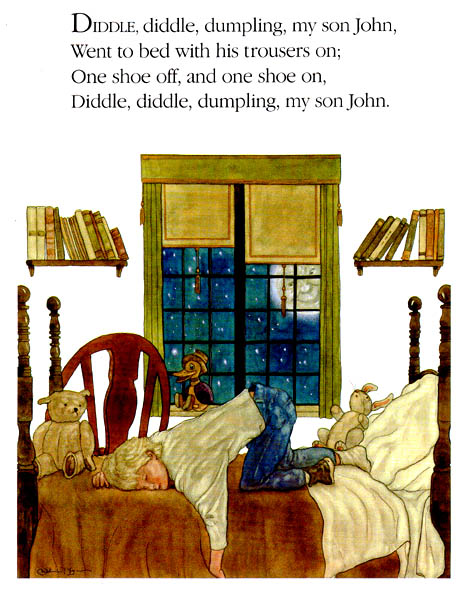
Diddle, diddle, dumpling, my son John,

Went to bed with his trousers on,

One shoe off, and one shoe on,

Diddle, diddle, dumpling, my son John.

The rhyme is first recorded when printed in The Newest Christmas Box published in London around 1797. It may be derived from 'Diddle, diddle, diddle Dumpling', a traditional street cry of hot dumpling sellers. It is thought that this rhyme was a mother's words to a typical boy child.

There are no origins in history found for Diddle Diddle Dumpling - it is merely a nonsense rhyme probably made popular and handed down from generation to generation owing to the popularity of the name John.

It is an interesting fact that this is the only old rhyme that uses the name John - all of the older poems use the colloquialism for John i.e. Jack.

(A little note here, my grandson is sometimes nicknamed Jac)

The name John may have been connected to John of Gaunt (1340 - 1399) who was a rich and powerful Plantagenet prince. His liaison with a commoner called Katherine Swynford produced four illegitimate children who were given the name Beaufort (He married Katherine in 1396 and their children, by this time adults, were legitimised). Their son John was the Great-Great Grandfather of King Henry VIII of England.

The phrase "Diddle, diddle, dumpling" means "toddle, toddle, plump little kid" (dumpling meaning plump little kid in a friendly sort of way).
The Collaborative International Dictionary of English (from a web dictionary) gives the definition for diddle as “to totter, as a child in walking.”
The Oxford Dictionary online gives the definition of dumpling as “a small, fat person”

(now I am definitely not saying that Jacob is dumpy or fat nor that he totters - its just the wording of the rhyme!!)

Denslow's Mother Goose (1901) has the first line as "Deedle Deedle Dumpling", as in the version from The Little Mother Goose (1912):

Deedle, deedle, dumpling, my son John,
Went to bed with his stockings on;
One shoe off, and one shoe on,
Deedle, deedle, dumpling, my son John.

The version of the rhyme below is from The Real Mother Goose (1916), illustrated by Blanche Fisher Wright. It's interesting to see how they name the clothing in their version:

Diddle diddle dumpling, my son John
Went to bed with his breeches on,
One stocking off, and one stocking on;
Diddle diddle dumpling, my son John.

And in the version from Harry's Ladder to Learning (1850) ‘stockings’ is changed to ‘shoe’

Diddle, diddle, dumpling, my son John
Went to bed with his breeches on;
One shoe off, the other shoe on,
Diddle, diddle, dumpling, my son John.

Here's the Scottish version as found in A Book for Bairns and Big Folk, Children's Rhymes, Games, Songs, and Stories, 2nd edition (1904) by Robert Ford:

Hey diddle dumplin' my son John,
Went to his bed with his trowsers on;
One shoe off and the other shoe on,
Hey diddle dumplin', my son John.
Needless to say the version I know is more fitting for today's language and attire!

Sunday, May 12, 2013

Another Little Jacket


Jennifer and Jason are awaiting the arrival of their second child (our fifth grandchild) and with Jacob their first they haven't found out what sex it is.
Jennifer asked for some knitting so I have made this little jacket and hat of which I have now made four different colours. (green, yellow, pink and now this one). It is design number four from this Cleckheaton - Little babies including Premature Sizes pattern book.

I used Shepherd Baby Wool Merino 4 ply  in natural.

The middle size in the five choices is for a newborn and its the one I make for those first few weeks.

One thing I love about knitting baby clothes is that they are so quick and satisfying to make.


Friday, May 10, 2013

Chocolate Banana Health Cake


This is really an easy cake dessert to make. It might have a few ingredients but it’s a one bowl/pot mix and doesn’t need creaming of butter or use any eggs. I make it by melting the first three ingredients in a bowl in the microwave but you could do it in a pot on the stove.

It’s a recipe I have had for years so have no idea where it came from. I have made it for hubby’s morning tea shout on his birthday and here as a dessert at our monthly book club at our home. It’s one of those cakes that never seems to fail and has an interesting texture and taste but still the moist chocolate flavour.


125gr Butter
1 cup Sugar
1 Tbsp golden syrup
1 large banana - mashed
½ cup semolina
1 tsp baking soda
1 cup hot milk
1 tsp baking powder
½ cup wholemeal flour
1 cup flour
1 Tbsp cocoa

Melt the butter and sugar.
Add the syrup and gently melt. Remove from heat and beat well.
Add the mashed banana and stir in the semolina.
Blend the baking soda into the hot milk (It will puff up so watch it doesn’t foam over!)
Add the milk mix alternatively with the other dry ingredients and fold in to combine but not over mix.
Pour into a greased and lightly floured 20 cm ring tin.
Bake for 30 minutes at 190°C.

When cold ice with chocolate icing or serve warm sprinkled with icing sugar and with cream and/or yogurt as a desert.

Friday, May 3, 2013

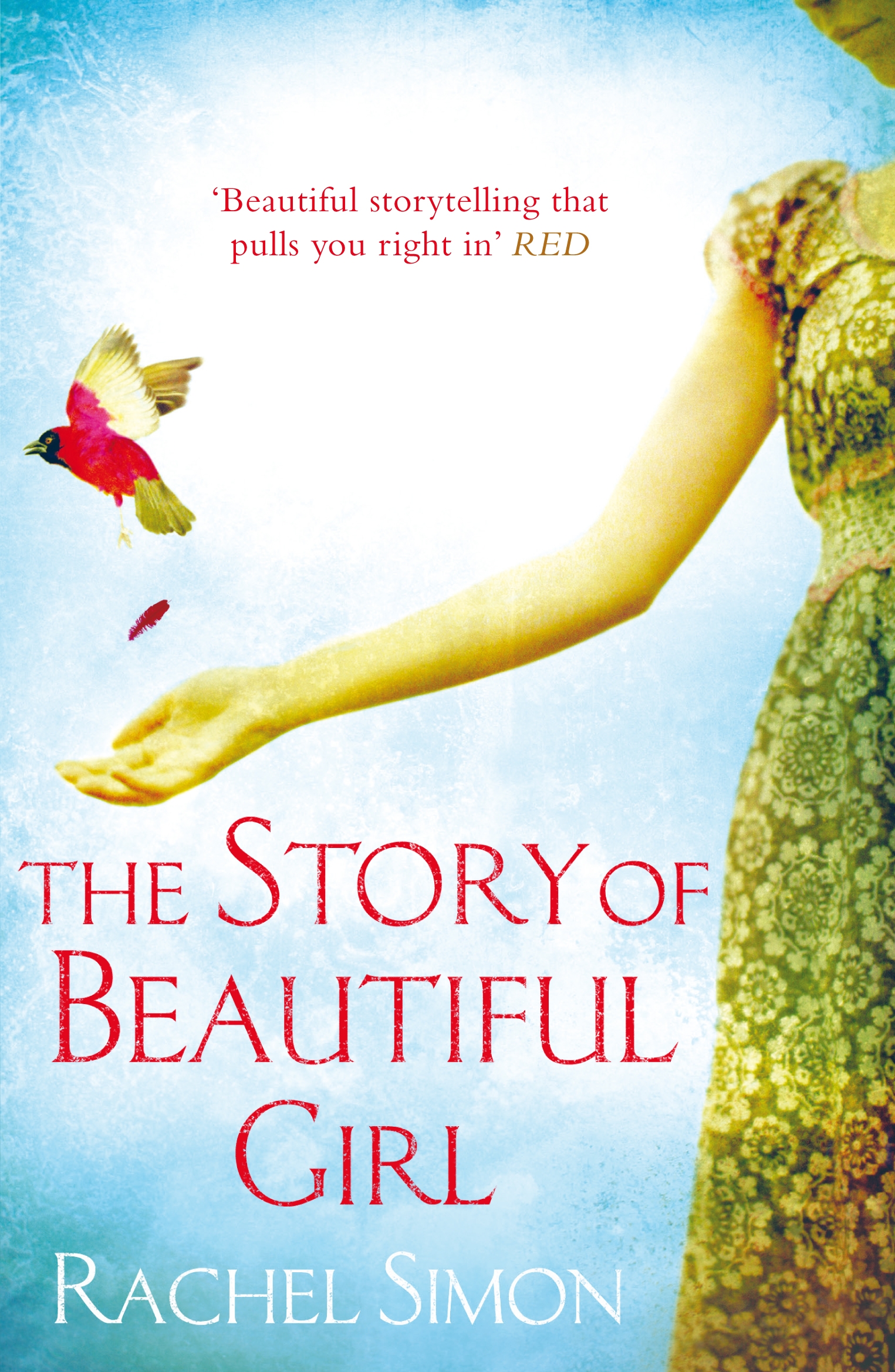
The Story of Beautiful Girl


The Story of Beautiful Girl by Rachel Simon


This was our second Book Club book. It seemed interesting we had two books in a row on Mental Health Institutions but I found this one captivating not only in its story but also in the way the the Institutions in America  have changed over the years.
For our family have also seen the changes in these in the Waikato, from Tokanui to The Henry Bennett Centre.

Lynnie, a young white woman with a developmental disability, and Homan, an African American deaf-mute man, are locked away in an institution, the Pennsylvania State School for the Incurable and Feebleminded, and have been left to languish, forgotten. While this school and many others like it have been closed, as a people we still have much to do to show compassion towards others that are different from each of us.

The year is 1968, and most Americans (and possibly most of the word) are convinced that institutionalization, rather than education, social services, or humaneness, is the only reasonable response to individuals like Lynnie and Homan. Deeply in love, they escape, and find refuge in the farmhouse of Martha, a retired schoolteacher and widow.
But what an institution they've fled --- a place that's unimaginably filthy and corrupt, where residents are routinely restrained, punished and terrorized by the guards, where friendship and compassion are all too hard to find.
Lynnie a beautiful young woman who has voluntarily stopped speaking and Homan (known to Lynnie as Buddy, but to most only as Number 42), have escaped from the school. They harbor a dangerous secret --- Lynnie is pregnant and it is imperative to the two that the baby not be born under those circumstances.
The story begins with the night the baby girl is born as they run from the school. It’s windy and rainy and the two stumble upon the farmhouse of Martha Zimmer. Martha, an older woman, opens her door to two bedraggled wanderers. Both are wrapped in makeshift blankets composed of old signs, and neither one can speak. While Martha is not sure how or why they chose her door, what is obvious to her is the affection they have for each other, and that they are seeking refuge. As Lynnie (known only as Beautiful Girl to Homan) removes her wet outer clothes, she unwraps a just-born baby girl. Hiding in her attic where they had felt safe, they are discovered when a little later that night, there is a second knock on the door, and it is the authorities from School looking for two escaped inmates. Desperate to find a better life for her baby, Lynnie throws herself on Martha's mercy, whispers two words to Martha: "Hide her”, as she leaves her daughter with this quiet, trustworthy woman.  But, the authorities only find Lynnie, as Homan has escaped into the dark undetected and the baby is left behind in the hopes that Martha will look after her.
Lynnie is hoping that she will not be isolated when she is returned to the school, as how else will Homan find her again. While escaping Homan is thinking on how to get back to the school to rescue Lynnie, and Martha needs to decide whether she will honor Lynnie's request.
When Lynnie is returned to the school, we learn of the horrors, and the mistreatment she and others had to endure. Homan continues his escape, but the two --- neither of whom can tell their story --- remain separated for nearly 40 years.

And so begins the epic journey of Lynnie, Homan, Martha, and baby Julia- lives divided by seemingly insurmountable obstacles, yet drawn together by a secret pact and extraordinary love. Over the course of the next 30 years we share their ups and their downs, their worries and their happiness. Lynnie never gives up her love of Homan and knows one day he will return for her. Life returns to normal for no one in this thought-provoking book. Martha, whose telephone rings only on December 24, when her former students call to arrange a visit on Christmas day, finds her life changed as she cares for baby Julia. Martha spends the remaining years in a constant state of fear that the secret will be found out and the baby will be removed from her care. Enlisting her past students, each of them plays a role in hiding Martha and the baby until the day that Lynnie or Homan return. The child draws people into Martha's life and gives her newfound purpose. Homan travels about the country with no way of knowing where to find Lynnie, he doesn't even know her name, but as fate would have it, he is lead to the one place they shared in common, Lynnie's love of lighthouses.
As their lives continue in parallel, as their memories of that stolen time together and their hopes for their absent daughter continue to flourish, Homan and Lynnie prove to the world --- and to themselves --- exactly what they're capable of. 

In her bestselling 2002 memoir, RIDING THE BUS WITH MY SISTER,
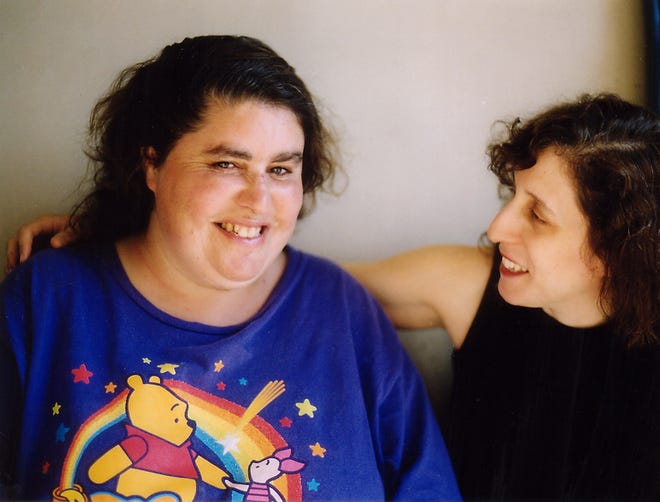
Beth and Rachel
 Rachel Simon introduced readers to the challenges, heartaches and rewards of having a family member with a developmental disability. The memoir chronicles the year Ms. Simon spent accompanying her sister Beth, who is afflicted with an intellectual disability, on joyful bus rides through a city in Pennsylvania. Though this experience, the author gleaned an understanding of the inner life of the developmentally disabled as well as interviews with people who had been wrongfully

institutionalized and professionals who staff group homes. Haunted for years by the story of an unidentified, deaf African American man found wandering the streets in Chicago, Ms. Simons captures the essence of both in the novel THE STORY OF BEAUTIFUL GIRL, she says, "Burst out of me like nothing before." At the same time, she showed us the complexity and often misunderstood nature of disability, factors that may be unfamiliar to the general public but are well known to Ms. Simon.
THE STORY OF BEAUTIFUL GIRL has a personal angle and a political agenda, to be sure --- just one glimpse at the descriptions of the so-called School and a glance at the author's note, and readers will grow outraged by the atrocities that actually happened not so very long ago. Even more important, however, is the way in which Simon utilizes the inner monologues of Lynnie and Homan to enhance their humanity in a much-needed and too-rare way. Seeing inside their heads, coming to know them as thinking and hurting and loving people, comes far closer to knowing the disabled and empathizing with them than most readers ever would on their own.
The book's dedication reads, "For those who were put away." Although Ms. Simon's awareness of the institutional life forms a backbone for the book, it is her insight into the indomitable spirit of the human soul that infuses The Story of Beautiful Girl with brilliance and honesty.

Rachel Simon is the award-winning author of six books and an American nationally-recognized public speaker on issues related to diversity and disability. Her titles include the bestsellers, The Story of Beautiful Girl and she is best known for her critically acclaimed, bestselling memoir Riding The Bus with My Sister. Both books are frequent selections of book clubs and school reading programs around the country. Riding The Bus with My Sister has been adapted for theater and Hallmark Hall of Fame, whose adaptation starred Rosie O' Donnell and Andie McDowell, and was directed by Anjelica Huston.


Wednesday, May 1, 2013

Feijoa Chutney


Ingredients

500g feijoas
500g onions
1 cup dates
1 cup raisins
1 cup brown sugar
2 tblsp salt
500mls malt vinegar
½ tblsp curry powder
½ tblsp ground ginger
½ tsp cayenne pepper
½ tsp ground cloves
   
Wipe feijoas, trim ends and chop.
Peel and finely chop onions.
Coarsely chop raisins and dates.
Place all in a large saucepan, along with the other ingredients.
Bring to the boil, stirring well.
Cook gently for 1½ – 2 hours until the chutney is thick.
Stir on occasion during this process to make sure it doesn’t catch on the bottom of the saucepan.
Spoon into hot clean jars, and seal.
Best stored for at least a month before using.

The picture above shows feijoa chutney served with my self crusting quiche

Tuesday, April 30, 2013

ANZAC day 2013

For ANZAC day this year I was asked, in my Lay Ministry role, to give a talk, blessings and prayer on 'ANZAC day' at the Kingswood Rest Home in Matamata specializing in the 24 hour care of people who have been assessed as requiring Stage 2 or 3 Dementia Care.

I visited there on the Wednesday before and met some of the residents and became familiar with who I would be talking to.
I was asked to keep it short as some could only have an attention span of about 20 seconds. So I started with the words below, appreviating it if I felt the need to do so.

However they were all very attentive and so I didn't reduce it by much at all.

I started with the verses from Matthew that I have highlighted in yellow.


Some verses from Matthew 5:1-12

1 Now when Jesus saw the crowds, he went up on a mountainside and sat down. His disciples came to him, 2 and he began to teach them.
He said:
3 “Blessed are the poor in spirit, for theirs is the kingdom of heaven.
4 Blessed are those who mourn, for they will be comforted.
5 Blessed are the meek, for they will inherit the earth.
6 Blessed are those who hunger and thirst for righteousness, for they will be filled.
7 Blessed are the merciful, for they will be shown mercy.
8 Blessed are the pure in heart, for they will see God.
9 Blessed are the peacemakers, for they will be called children of God.
10 Blessed are those who are persecuted because of righteousness, for theirs is the kingdom of heaven.
11 “Blessed are you when people insult you, persecute you and falsely say all kinds of evil against you because of me.
12 Rejoice and be glad, because great is your reward in heaven, for in the same way they persecuted the prophets who were before you.”

We are not a perfect society, there are many areas of life where things could be better, but the basic freedoms we have ensure that we can look to our future with hope.

Today is Anzac day which calls to mind another aspect of life in New Zealand that I am thankful for.  I have never had to face some of the difficult decisions of older generations:  particularly the decision to go to war.  The point I am making is that younger generations have a different viewpoint on commemorations such as Anzac day because we have no personal memory of the wars of the 20th century.

While April the 25th was originally set aside to remember the events of Gallipoli during World War 1, our understanding of Anzac Day has expanded to include all wars where New Zealand and Australia soldiers fought and died.  The remembering of the sacrifices of our soldiers is an essential aspect of Anzac day but is not limited to that.  

We are very fortunate to live in New Zealand at this time. New Zealand is a very special place and we are truly blessed. Not only is it a beautiful country, we are free from war, invading nations and are considered a safe land.

Anzac day is an opportunity to reflect on the overall impact of war.
The remembering of the sacrifices of our soldiers.
We remember those who served in the armed forces who have now passed on but are thankful they returned home.
We also think of the families who lost loved ones, for those who had to wait at home hoping for the best.
We think of the places where war destroyed communities and took innocent life.
All of these ideas are summarised in the words, lest we forget.

 ♥Lest we forget these brave soldiers going into war just to protect our freedom ♥
 ♥ risking their own lives for the sake of others back home, ♥
 ♥you all brave soldiers are in our hearts and never forgotten ♥


They shall not grow old, as we that are left grow old;
Age shall not weary them, nor the years condemn.
At the going down of the sun and in the morning
We will remember them.

God bless them all.

I followed with Let us pray

Father God, We thank You that we have this day to remember the impact of War.
We ask that You be with all those in our forces who are still involved in military activities.
Protect them as they do their tasks.
We pray for peace and understanding for all.

Then I followed with grace.
Thank You for this day here with family and friends.
Thank You for this wonderful food we are about to share.
We ask You to bless it and especially those who have prepared it.
Bless us all this day and always in the name of Jesus Christ.
Amen


These people may be suffering from dementia but they certainly didn't forget the words 'lest we forget'
When I had finished my little thoughts on Anzac day with those three words, there was an echo around the room as the men mainly, all repeated "lest we forget"
I felt so touched and realised how much of a privilege it was to share this day with them.

After I had said a grace we all shared a meal of finger food.

Before I left I went and said good bye to each resident as I was so touched to be with them all that day.

All scripture is taken from New International Version 1984