Sunday, August 31, 2014

Three Little Kittens and My Lost Mittens

I had come to a bit of a standstill with my knitting as I had started a little jacket for one of my grandchildren with some lovely red mohair but I had but run out before I had finished. I couldn't find any in the shops to finish it so I had just stopped altogether.

Then I remembered that I had promised to make some mittens for Kate so quickly made one pair and posted them off.
After the weekend I had spoken to my daughter and she hadn't mentioned them. I thought that was a long time for them to get there and my impression of the New Zealand postal service lowered a bit. However Monday morning there in the letterbox was my parcel - returned!
Insufficient Postage thank you very much!


"Right", I thought, "I'll fix them!" I opened up the parcel, took some photos (as I had forgotten to for the first ones) and slipped the second pair I had made over the weekend in as well. I then "peeled off" the label, affixed the correct postage and sent them off again.

I was reminded of the nursery rhyme

"Three Little Kittens"

Three little kittens they lost their mittens, 
And they began to cry, 
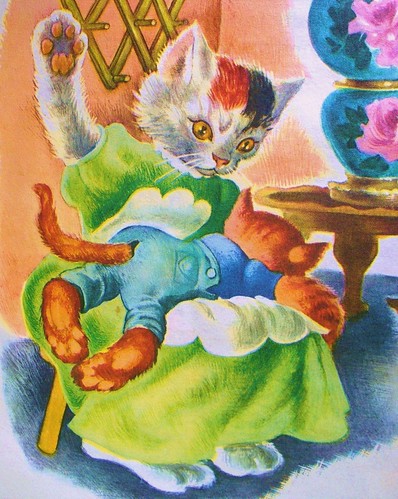
Oh, mother dear, we sadly fear Our mittens we have lost. 
What! lost your mittens, you naughty kittens! 
Then you shall have no pie. 
Mee-ow, mee-ow, mee-ow. 
No, you shall have no pie. 

The three little kittens they found their mittens, 
And they began to cry, 
Oh, mother dear, see here, see here, Our mittens we have found! 
Put on your mittens, you silly kittens, 
And you shall have some pie. 
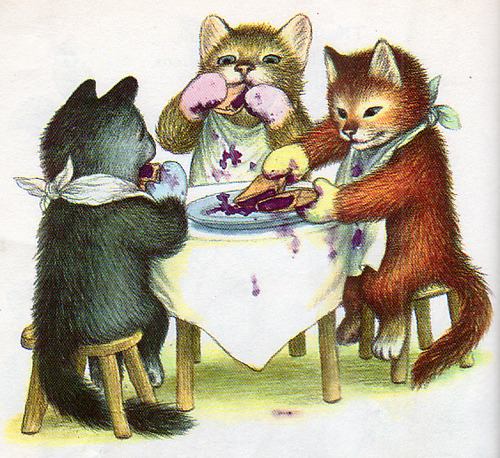
Purr-r, purr-r, purr-r, 
Oh, let us have some pie. 

The three little kittens put on their mittens, And soon ate up the pie; 
Oh, mother dear, we greatly fear Our mittens we have soiled. 
What! soiled your mittens, you naughty kittens! 
Then they began to sigh, 
Mee-ow, mee-ow, mee-ow. 
Then they began to sigh. 

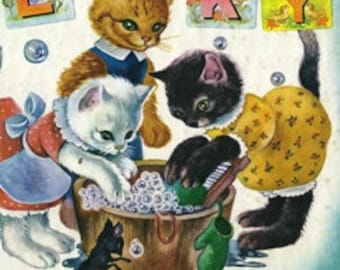
The three little kittens they washed their mittens, And hung them out to dry; 
Oh! mother dear, do you not hear, Our mittens we have washed! 
What! washed your mittens, then you’re good kittens, 
But I smell a rat close by. 
Mee-ow, mee-ow, mee-ow. 
We smell a rat close by. 

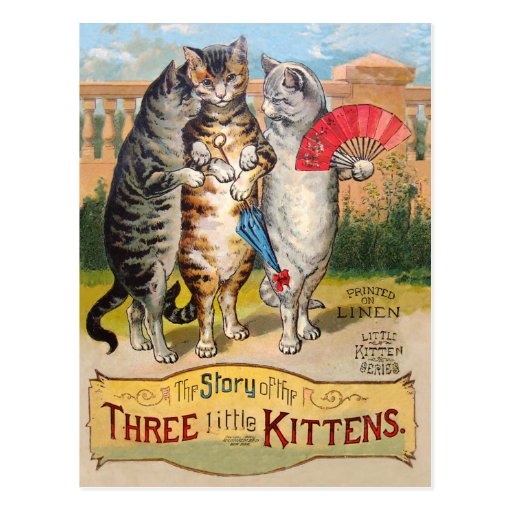
Historical Background "Three Little Kittens" is an English language nursery rhyme, probably with roots in the British folk tradition. It dates to before 1858, when R. N. Ballantyne wrote an amplification of the poem under the championship The Three Little Kittens, published as region of the Good Little Pig's Library, book 1. An often late edition of the tale was published under the Little Golden Books impression in the United States. The rhyme as published today, however, is a sophisticated piece usually attributed to American poet Eliza Lee Cabot Follen (1787-1860). The poem was first published in Britain in 1833 as an anonymous addition to a volume of Follen's verse “Little Songs for Little Boys and Girls”. and in the United States in 1843. Follen may have developed and refined an existing, rude version of the poem, and, in the process, made it her own. With the passage of time, the poem " was hugely popular and quickly absorbed into the Mother Goose collection, “Only True Mother Goose Melodies” in 1843. Its tune is a variant of “The Seven Joys of Mary.” It has a Roud Folk Song Index number of 16150

You can read more about its origins here.

“Three Little Kittens” tells a cautionary tale of three kittens, who first lose, then find and soil, their mittens. When all is finally set to rights, the kittens receive their mother's approval and some pie. The profound significance of these verses represents a typical situation involving the relationship between a mother and a child. The child, represented by kittens and the common occurrence of losing an article is subsequently punished. Then finding the lost item, the child is finally rewarded for the good deed.

The word "meeow" shows effective use of onomatopoeia where a word sounds like the action. The mother cat was correct in her view that she could "smell a rat!" It may have been that the kittens had indeed been playing with a rat. The fact that the kittens saw the reward in finding their mittens meant they could have pie, suggesting that good behaviour was rewarded; when their mittens were soiled and they were pronounced naughty, supposes that they washed them to be rewarded again. However “Mother” saw through them!
The poem is a sophisticated production considered a cornerstone in the shift from moral literature of 19th century children's literature, in favour of anthropomorphic fantasy, satirical nonsense, and word play. It is one of the first pieces of children's romantic literature produced for amusement and entertainment, and may be the source of the idiom "to smell a rat".

The poem can be learnt in a request and reaction choral manner featuring the sound of a storyteller and the voices of the kittens. Like most rhymes, this verse is unnamed.

So the mittens I made were in a pure wool. I didn't use a pattern as they are generally just a simple 'bag' with a curved top. I made one with a rib cuff feeding some hat elastic through for tightness and the second had a simple picot edge with a band that I was able to thread some thin elastic through. The second pair also had a little 'snowflake' pattern knitted on the back. 


Friday, August 29, 2014

The Wives of Henry Oades

Our latest book club read was The Wives of Henry Oades by Johanna Moran.

An interesting easy read, some of which is set in early settler Wellington in New Zealand and some in America.

In 1890, Henry Oades accepts an accountancy post in New Zealand and undertakes the arduous sea voyage from England to New Zealand in order to further his family's fortunes. When Henry, his wife, Margaret, and their children follow him to exotic Wellington they desire to live further out from the city. But while Henry is an adventurer, Margaret is not. Here they settled on the lush but wild coast where their new home is rougher and more rustic than they expected. It wasn't long before disaster struck in the most unexpected of ways. One night of tragedy shatters the family when a local native Maori tribe stage an uprising, incensed at their treatment at the hands of the settlers. They kidnap Mrs Oades, her four children and a young boy who was visiting with his mother at the time, and vanished into the rugged hills surrounding the town while Henry is away.

For months Henry, at first refusing to believe his wife could be dead, scours the surrounding wilderness, until all hope is lost and his wife and children are presumed dead. Having searched ceaselessly for his family, two grief-stricken years later he is forced to conclude that they must be dead. Henry books a passage to California and in his despair he ships out to San Francisco to start over. There he marries Nancy Foreland, a young widow who's husband died while trying to save their fortune of savings in a jar from their burning house. Nancy was pregnant with their first baby, and when she has given birth Henry takes pity on her and marries her, even though he had declined a previous proposal from a housekeeper who lived in the home of his benefactor. It seems they’ve both found happiness in the midst of their mourning—until in 1899, Henry’s first wife and children show up, alive and having finally escaped captivity.

Unbeknown to Henry all but one of his family have survived the abduction and Margaret Oades and her children were leading a miserable existence, enslaved to the local tribe. Margaret also cared for a family friend's son who had also been caught up in the abduction. His mother's remains were finally announced to be the charred body that was buried by the burnt out home of the Oades when their home was first discovered in ruins. When they contracted smallpox after five years of captivity they were cast out and are finally let free. Ill and footsore, they make their way back to town, years after they were presumed dead. Discovering that Henry was now half a world away, they were determined to rejoin him. Leaving the boy she had cared for with his father in New Zealand they sail as workers on a boat to pay for their passage and months later they arrived on Henry's doorstep in America and Henry Oades discovered that he had two wives and many dilemmas.

Margaret is quite determined to some how have her husband reunited with her and the children but although Henry says he has loved her he shows no passion and is devoted to his new wife. So as not to abandon any of them they proceed to live in the same homestead on the ranch he inherited from the owner he had worked for after arriving in America.

Narrated primarily by the two wives, and based on a real-life legal case, The Wives of Henry Oades is the riveting story of what happens when Henry, Margaret, and Nancy face persecution for bigamy. Exploring the intricacies of marriage, the construction of family, the changing world of the late 1800s, and the strength of two remarkable women, Johanna Moran turns this unusual family’s story into an unforgettable page-turning drama.

This is a darkly comic but moving historical fiction debut about love and family, based on a controversial court case from the early 1900s.

I found Henry quite annoying in the end.
I felt he should have left the second wife and renewed his marriage with his first wife Margaret and the children. Margaret had done so much with and for him and the children over the years. Even though he had moved on from the grief of believing in the end that she was dead, her escaping and following him to America showed her love for him. She longed for him to embrace her and comfort her at times. He seemed obsessed with Nancy the new wife and it would appear from the story that her youth and beauty caused him to lust for her. She in turn seemed quite naive and silly at times. It was mentioned once that her mother was the same age as Margaret. The disarray of these relationships caused his son to fall by the way and behave in ways he may not have, had he had a good solid example to follow in his parents.

Johanna believes the story is based on a true article her mother had been given by her father but an article in the Herald on Sunday questions this.

Sunday, August 10, 2014

A Special Seat Passenger

When I flew to Wellington for the second time to visit Theresa I prebooked my seat and number so I could get a window with a view and no obstruction from the wing.

I was running a bit late and when I asked the gentleman who was in the aisle seat next to mine, before I got there if he could possibly move, (so I could get my big body past him) he said "Certainly" (not the big body bit - that was all in my head!) I thought 'I recognize that voice.'

I sat down arranging my bag and he offered to put my coat in the over hanger locker and I thought I do know him ... well he didn't know me of course, but when you have seen someone on TV often enough you sure know them by sight and by voice.

I said "Hello.. are you Aaron?",
"Yes" he replied and that set me off.


Aaron Brunet was the winner of Masterchief NZ 2013 .

Poor guy we chattered all the way to Wellington about this and that. Too bad if he was hoping for a bit of a rest, but they say if you are famous you have to expect it!!!

He lives in Raglan with his lovely wife and daughter.

Life after winning has been busy and he has just launched his new book "Cook With Me".
He was flying to Wellington and the Wairarapa doing a couple of fun events: Yarns in Barns on the Tuesday evening with Jo Crabb, at Opaki School, Waipipi. Then on Wednesday morning at Moore Wilson demonstrating some recipes from his book.

I asked him some things about the programme that we don't see on TV and we shared stories about our children.

Although he really appreciated what Masterchief had done for him he was keen to get back to his love of making sour dough bread.

Saturday, July 26, 2014

A New Creation.

With all the baby clothes I have knitted over the last few years I am beginning to build up a few end of balls in different colours.
I am never quite sure what to do with these and have used some to make crochet squares to make into blankets. I have also made knitted soft toys, but I found a use for a few of the softer shades.


Our latest grand child is a girl, Kate, but her mother isn't that keen on pink so we are not allowed to give her pink things.
Well I don't think that is fair as a girl is a girl and if she wants pink then you have to let her, surely.

Well I found a way to get a little pink into her clothes ;)

Using a pattern for a yoke necked jacket from Cleckheaton No. 425 Little Babies - volume 2, I knitted a basically white jacket with some colour added in with a Fair Ilse yoke and border.

I used left over pink and green wool and the white in the pattern was a different shade to the main garment and this way I used up nearly four end of balls.

I just made up the pattern as I went along depending on how much of each colour I had left as the garment was nearing completion.

This jacket is commenced at the neck for the circular yoke. You divide for the sleeves and the fronts and backs are then joined and knitted so the only seams are down the sleeve.

Thursday, July 3, 2014

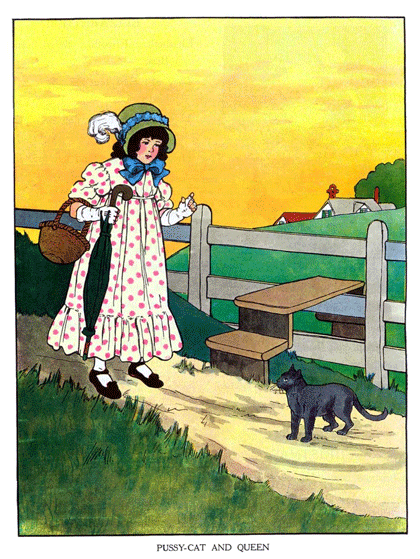
Pussy Cat, Pussy Cat, Where Have You Been?

"Pussycat pussycat, where have you been?" 
"I've been up to London to visit the Queen."
"Pussycat pussycat, what did you there?" 
"I frightened a little mouse under her chair" 
"MEOWW!" 

Common modern versions include:
Pussy cat, pussy cat, where have you been?
I've been to London to look at the Queen.
Pussy cat, pussy cat, what did you do there?
I frightened a little mouse, under the chair.

The last line sometimes sung as: I chased a little mouse right under the chair.

The origins of the "Pussycat pussycat" rhyme dates back to the history of 16th century Tudor England.

One of the waiting ladies of Queen Elizabeth Ist, the fifth and last monarch of Tudor England, had an old cat which roamed throughout Windsor castle. On one particular occasion the cat ran beneath the throne where its tail brushed against the Queen's foot, startling her.

Luckily 'Good Queen Bess' had a sense of humour and decreed that the cat could wander about the throne room, on condition it kept it free of mice!

The earliest record of the rhyme is found in the publication "Songs for the Nursery," printed in London in 1805. The melody commonly associated with the rhyme was first recorded by the composer and nursery rhyme collector, James William Elliott, in his "National Nursery Rhymes and Nursery Songs" (1870).

The Queen most often depicted in illustrations is Elizabeth I, but Caroline of Brunswick has also been suggested

Percy B. Green, author of A History of Nursery Rhymes (1899), wrote the following about the Pussycat, Pussycat nursery rhyme: "No doubt the incident giving rise to this verse had to do with the terrible fright Queen Bess (Elizabeth) is supposed to have had on discovering a mouse in the folds of her dress - for it was she of virgin fame to whom pussy-cat paid the visit.

It has been asked again and again, 'Why are old maids so fond of cats?' and 'Why are their lives so linked together?' Maybe it is to scare, as did the cat in the rhyme, 'a little mouse from under her chair.'"

James Orchard Halliwell wrote the following about Pussycat, Pussycat in his book "The Nursery Rhymes of England" (1843): "There is an old proverb which says that 'a cat may look at a king.' Whether the same adage applies equally to a female sovereign, and is referred to in the nursery song, or whether it alludes to the glorious Queen Bess, is now a matter of uncertainty."

While staying at my parents I discovered they were often visited by a cat. He would arrive in the mornings and after a good scratch of his ears and a few cat biscuits he would then roam the house looking for a warm spot to snuggle up in. Sometimes he would go downstairs to where the night store was kept on to dry the clothes and other times he would snuggle down on my mother’s feet as she rested on the couch. On one occasion he slept on my bed.
 
Dad commented that sometimes he wouldn’t come for a few days and after I had been there for a week I realised he would arrive early on week days leaving as the night drew in and kept away at the weekends. I supposed that perhaps his owners shut him out when they went to work but on weekends he was allowed inside during the day.

Needless to say he would arrive at Mum and Dads, sometimes entering in a downstairs door wondering up the stairs to linger for a while and then disappeared out a front door to proceed across the road and up to another place. They have no idea where he lives or even in which direction he comes from but he sure is happy to stay in the warm with a few snacks on the days he does.

It made me think of the rhyme "Pussy cat, pussy cat, where have you been?" and wondered if its owners had any idea what it got up to when they shut him out.

Tuesday, June 24, 2014

McVan Lent Tartan

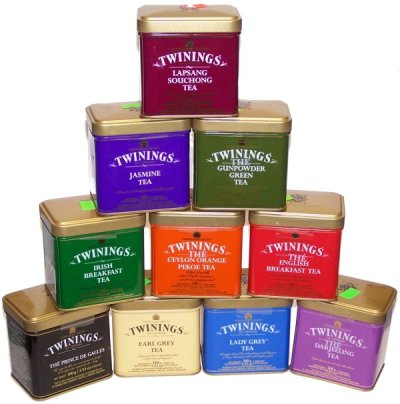
My Dad loves a cup of tea.
But he hates tea bags.
He has a two cup pottery teapot that he uses and a very large selections of Twinings teas. He has his favourites but he still has the occasional others.

His teapot cosy was wearing thin and needed a good wash so I thought I would make him a new one to have as a spare.

While In Wellington visiting them and our grandchild I found some wool and started to make a cosy to fit.
I wanted to make a tartan as Dad has Scottish ancestry and loves his tartans.
I didn't follow any particular clan and could only use the wool I had found.

I started doing just stripes and then stitched vertical strips to hopefully add thickness and so insulation.
Some how I had the idea of a tartan wrong so it didn't quite work.
Anyway it serves as a tea cosy which was the main idea.

When I stayed the second time Dad seemed quite chuffed with the cosy and called it his McVan Lent tartan.

The First Flight to Wellington

When I went to Wellington before Easter to see our new Kate and stay with my parents I flew down from Hamilton.
It was a Saturday late morning flight so as to miss any fog that may have closed the airport.
We left Tirau in what we thought was plenty of time to be on time for my final check in call.
Unfortunately it was the day Prince William and Kate who were touring New Zealand were due for a walk around in Cambridge and by the time we were pacing through traffic was heavy and there were delays.

Watching the clock tick by I phoned air New Zealand - twice - only to be told they would not be holding a flight for me.... well I wasn't asking that, just that I was going to be a bit late for check in and they still said it couldn't be helped. So we continued to drive as fast as was acceptable and made it to the airport 5 minutes after check in time.

Harry dropped me at the door and then went off to find a park while I raced to check in...

Well I was told it was fine.
The flight was delayed. Phew.
"Why?" I asked
"We are waiting for the arrival of another plane before the one you are booked on can land."

Dah

I knew what she meant... "the royals".

It was due in before the plane to leave for Wellington could land and even disemnbark its passengers.

By this time Jennifer, Jason and the grandchildren had arrived to wave Nana good bye.

So we played and waited...

Finally a large plane arrived.

Once it was stationary the huge air stairs were attached and the cars started to arrive ...

and arrive...

and arrive.

Who were all theses people?

There were so many and that also included huge vans with numerous seats.

We waited, the doors were opened and the people started coming out.

More and more people.

We wanted to see Kate and Prince William.

I mean we had a prime view up there in the airport viewing room and you can see I had my camera pointed to get a good view.

We were almost thinking this must be another flight of just officials etc and maybe the royals were already somewhere else as they had a few duties to attend to while in Hamilton and Cambridge.

But finally wearing a bright green Erdem coat, in fitting Waikato green colour the Duchess of Cambridge and Prince William emerged from inside the plane.

Once they finally reached the ground they were met Hamilton Mayor Julie Hardaker and her husband Steve Perdia and talked with each. After another five minutes they waved and were escorted to their waiting separate cars and driven off to their appointments.


The tea party was held in a marquee with the Mad Hatter in attendance and jellied eyeballs, huhu grubs, flower pots of sweet chocolate mud and crispy chicken lollipops on the menu.

William paid a visit to aircraft factory, Pacific Aerodrome at Hamilton Airport, while Kate attended her first solo engagement of the tour - attending an Alice in Wonderland themed party at Rainbow Place hospice which provides care to kids experiencing grief, serious illness or the death of a loved one.
Afterwards, the couple will reunite to visit the town that shares their title, Cambridge, becoming the first duke and duchess of the title to do so.

Among the locals they'll meet is Cynthia Read, who was commissioned by the prime minister's office to knit a lace shawl for their son Prince George.

The royals then open a national cycling velodrome just north of Cambridge before returning to Wellington.

Soon the hype of the arrival reduced and the plane I was to board had arrived. The passengers disembarked and then another huge air force plane arrived with more "staff, reporters and other security and dignitaries" and they too were loaded into waiting vans and cars.

Finally the call came to board my plane and half an hour late, we were taking off on our way to Wellington.

It was a good day with the sun shining and with a window seat I was able to take some shots.

The Waikato farming land was finally starting to green up again after the second drought in two years.
However by the time we reached Wellington the clouds were thick again and the ride a little bumpy.

We landed arriving over the habour and straight down the runway.

Off the plane I was met by my Mum and Dad who took me around to see Theresa, Steven and baby Kate.

Now that seems familiar but we are told that the choice of baby name had nothing to do with the currant royals who just happen to be visiting New Zealand at the time.

Oh yes we are sure. All the same it is a nice name.

So with the opportunity of four generations of Mothers and Daughters we gathered around for some memorable photos.
Kate, Mum and Theresa
Kate (my grand-daughter), my mum, me and Theresa my daughter
Mum and Dad with Kate